
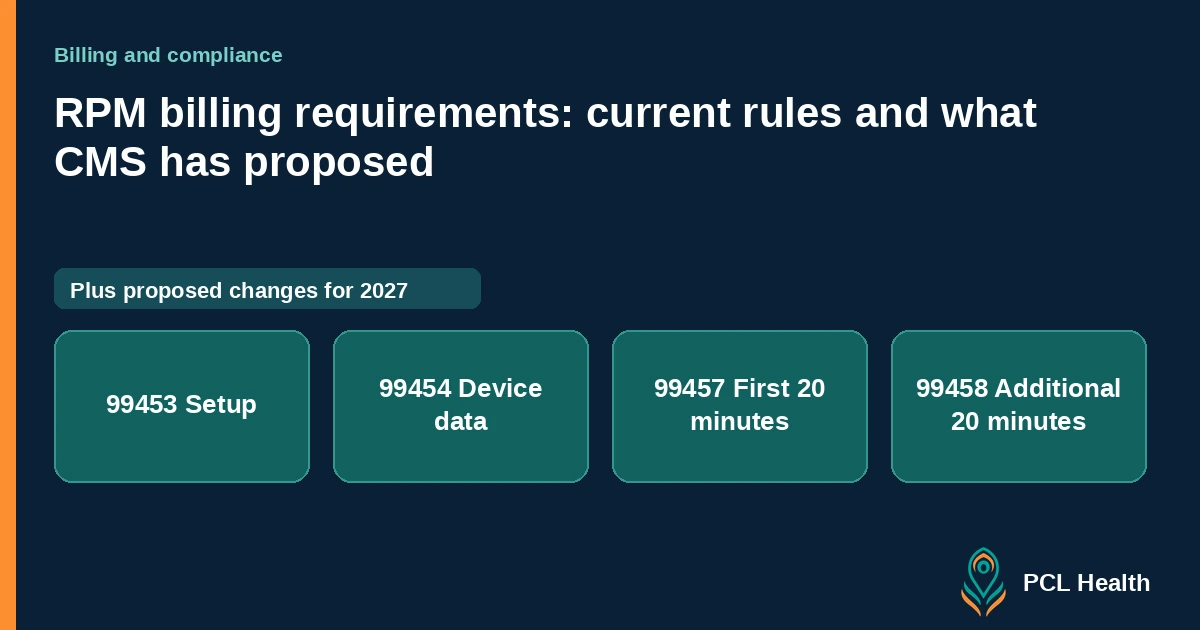
RPM billing requirements depend on the service delivered, the applicable code and the records supporting that service. Practices should apply current requirements and treat the CY 2027 staffing and initiating-visit changes as proposed, not effective policy. CMS MLN, December 2025 (2026 guidance) CMS proposed-rule fact sheet, July 14, 2026
What should a practice check before reviewing RPM claims?
Start with the patient, the service and the reporting period. Pull the monitoring reason, consent, setup note, transmitted readings and management activity into one review. Assign someone to check the evidence against the applicable payer requirements before deciding whether the documented work supports a claim. Review the evidence before releasing the record.
CMS describes RPM as a service involving patient education and setup, device supply, and treatment management. Current guidance also identifies an established patient relationship, medical necessity and consent as requirements. CMS MLN, December 2025 (2026 guidance) These are separate review questions; a large collection of readings does not answer all of them.
Open one patient’s record and follow the work through the reporting period. The reviewer should be able to find the monitoring purpose, responsible practitioner and period under consideration without reconstructing the story from unrelated screens. Use a consistent record location, even if your practice stores the supporting documents in more than one system.
At month end, your coordinator opens the review queue. One patient has readings but no visible setup note. Another has a setup note but unresolved transmission problems. Put each missing item into an exception queue with a named owner. Do not treat the two records as equally complete.
Who can bill RPM and what should the device-data review cover?
CMS limits remote-monitoring billing to physicians and non-physician practitioners eligible to provide evaluation and management services. Current guidance also requires a medical device as defined by FDA and electronically collected, automatically uploaded physiologic data. Only one practitioner can bill remote monitoring for a patient in a 30-day period. CMS MLN, December 2025 (2026 guidance)
Before onboarding, ask the patient and relevant care team whether another program is already providing monitoring. Put any uncertainty into the enrollment review rather than assuming that a device in the patient’s home belongs to your program. Confirm the responsible practitioner before you add the patient to your enrollment queue.
For the device review, retain the actual model and transmission workflow. A reading visible in an application does not by itself explain how the data arrived there. Ask the team to distinguish automatically transmitted device data from information somebody typed into a record, and send unresolved questions to the responsible reviewer.
How do the four familiar RPM CPT codes fit together?
The four familiar codes describe different work: setup and education, device supply and monitoring data, initial treatment-management time, and additional treatment-management time. Keep those categories separate in the record. Use the table to locate the relevant evidence, then check the current descriptor before your billing decision.
Use the current code descriptors when reviewing a claim. The 2026 final rule addresses the updated remote-monitoring code family; earlier descriptions should not be used as if nothing changed. CMS CY 2026 final rule, 2025 A staff member's memory of last year's process is not a substitute for a dated reference.
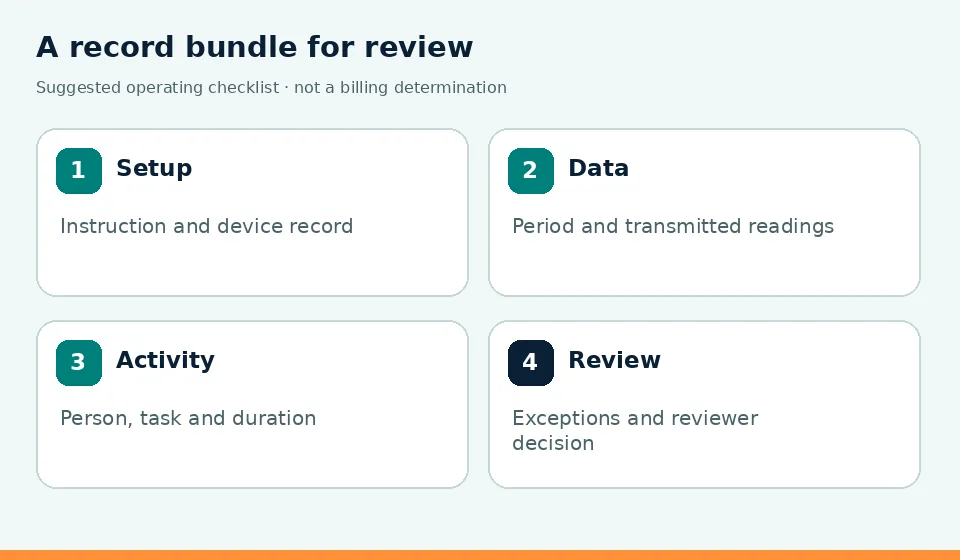
A useful record bundle includes a setup note, a device-data record and an activity record. The bundle should show the underlying service. A monthly total with no explanation of who performed the work is harder to review than entries that retain the date, task and responsible person.
PCL Health currently maps 99453, 99454, 99457 and 99458 and provides billing summaries. The RPM billing page explains the platform's documentation scope. Explore the RPM billing page.
| Code | Plain-language reference | Suggested record to review |
|---|---|---|
| 99453 | Initial setup and patient education | Setup date, teaching provided and device information |
| 99454 | Device supply and transmission for 16–30 days in a 30-day period | Monitoring period and qualifying transmission days |
| 99457 | Initial 20 minutes of monthly treatment management, with interactive communication | Activity entries and communication record |
| 99458 | Each additional 20 minutes of monthly treatment management | Additional activity entries, alongside the base service |
Code reference: CMS CY 2026 final rule (2025), Table A-E11. This table summarizes the categories rather than reproducing full CPT descriptors.
Does every RPM code use the same day or time threshold?
No. Device-data periods and treatment-management time describe different parts of the workflow. Review the applicable descriptor before applying a threshold, and keep a calendar-month activity record distinct from a 30-day device-data period. A practice should not use a single green status indicator as the entire basis for its billing review. CMS CY 2026 final rule, 2025
The 2026 code family includes 99445 for shorter device-data periods and 99470 for shorter treatment-management time. Check the shorter-period options when a patient’s record falls below the familiar day or time thresholds. CMS CY 2026 final rule, 2025 PCL Health does not yet map 99445 or 99470.
The 2026 final rule also adopts the updated 99453 guidance, including two days of monitoring rather than the older sixteen-day setup threshold. CMS CY 2026 final rule, 2025 Do not carry an older setup checklist forward unchanged. Have the billing reviewer check the current descriptor and related instructions for the service under review.
Operationally, label each report with the dates it covers and the category of work it measures. When you compare two reports, check whether the difference comes from the period, transmitted days or staff activity. Avoid a spreadsheet column called only 'RPM complete' because it hides those distinctions.
When a reading arrives late, preserve the original timestamp and investigate the transmission path. Do not replace missing evidence with a guessed date. Give the billing reviewer an explanation of the discrepancy and let the reviewer assess the applicable rules.
What counts as interactive communication for treatment management?
CMS describes interactive communication for 99457 and 99458 as a real-time, two-way conversation. Time can include qualifying care-management work as well as that conversation; the entire time requirement is not necessarily telephone time. An automated AI call should not be presented as satisfying this practitioner or clinical-staff communication requirement. CMS CY 2021 final-rule fact sheet, 2020
Separate a reminder event from a clinical interaction in the activity record. A reminder that prompts a patient to take a reading can support the program, but the reminder's existence does not show that the required conversation took place. Likewise, a note saying 'called patient' is incomplete operational evidence if nobody can tell whether the call connected.
Record the outcome in clear terms: reached patient, reached caregiver, no answer, voicemail, or automated reminder. These outcomes tell you whether to schedule another contact, resolve a device problem or pass the record to your billing reviewer.
For example, a coordinator can see that a reminder ran in the morning, then separately document a later staff conversation. Preserve both events without counting the automated call as staff time by default. Your billing staff can review the documented human work and the communication record together.
How should staff document care-management activity?
Record the person, date, task, duration and connection to the patient's monitoring plan. Use entries that explain the work rather than unexplained timers. Decide how staff correct errors and how reviewers identify possible overlap. Make those entries available to your billing reviewer, alongside the relevant payer requirements.
Make the task description concrete. 'Reviewed transmitted readings and prepared an issue for clinician review' gives a reviewer more context than 'RPM work.' If the entry concerns troubleshooting a device, say so. Distinguishing activities helps the reviewer ask the right questions rather than assuming every task belongs in the same billing category.
Where a patient receives other care-management services, CMS permits certain concurrent services when time and effort are not counted twice. CMS MLN, December 2025 (2026 guidance) Keep the records distinguishable and have a reviewer investigate apparent overlap rather than assigning the same minutes to two programs.
Build a correction process that preserves the reason for an edit. A mistaken timer should not become an invisible adjustment to a monthly total. Ask your staff to explain the correction, and have the reviewer check whether the revised record still tells a coherent story. Give your reviewer both the corrected activity entry and the reason for the change.
How can a practice organize the month-end review?
Use a short, repeatable review with separate checks for setup, device data, activity and communication. Route missing evidence to an exception queue before submission decisions. Assign a reviewer and a resolution owner, and preserve the outcome. Keep the reviewer’s decision and the evidence used to reach it together.
Review a small group of records together to test the process before expanding the queue. Ask whether a second reviewer can locate the same evidence and reach the same operational understanding. Disagreement about where a document lives is a workflow problem worth fixing before staff face a larger workload.
Keep rejected or incomplete records visible to the team that can correct them. If a patient never received usable setup support, an exception should reach the coordinator responsible for onboarding. If an activity entry is ambiguous, send it to its author rather than asking a billing reviewer to invent a description.
Make a simple checklist part of the review meeting. Staff should know who can resolve each category and who makes the final submission decision. Retain the checklist version so a future review can distinguish a process change from a change in the patient's record.
- Confirm the patient and reporting period.
- Locate setup, consent and device information.
- Review transmitted data and unresolved exceptions.
- Review activity entries and the separate communication record.
- Resolve discrepancies and record the reviewer decision.
What has CMS proposed for 2027?
CMS proposes practice-employed clinical staff and a separately reportable initiating visit for RPM. CMS also seeks comment on consolidating RPM and RTM codes into four G-codes. These are proposed changes or a comment solicitation, not current requirements. CMS proposed-rule fact sheet, July 14, 2026 CMS CY 2027 proposed rule, 2026 Keep preparation separate from the instructions staff use today.
If finalized, the staffing change would take effect on January 1, 2027, the date CMS proposes. CMS CY 2027 proposed rule, 2026 Comments closed on September 14, 2026. CMS regulation notice, 2026 The proposal also lowers payment valuations for some remote monitoring codes by changing device-supply inputs and removing practice-expense inputs for treatment-management codes. CMS CY 2027 proposed rule, 2026 CMS proposed-rule fact sheet, July 14, 2026 You could continue purchasing vendor software, devices and platforms while directly employed clinical staff provide the services, because the proposed staffing clause addresses clinical-service delivery. CMS CY 2027 proposed rule, 2026
Review two budgets before you commit to a staffing change: one using current payment assumptions and one allowing for the proposed valuation changes. Include nurse coverage, onboarding time, device costs and the software contract. Keep the final-rule review as the approval point for your revised operating plan.
Start your impact review with the people doing the work. Map who performs each task, who employs that person and what the practice would need to change under the proposal. Keep the present workflow and the contingency workflow in separate documents.
Avoid turning a draft policy into a patient communication before the practice has reviewed the final rule. Preparing appointment capacity, staff coverage and contract questions is reasonable. Give your team a dated procedure change only after you have reviewed the final rule.
What should the practice do while the final rule is pending?
Continue reviewing current services under current rules while assigning an owner to monitor the final rule. Prepare changes that can be evaluated without committing to them: staffing maps, onboarding documentation and adaptable reports. Record the date of each policy review so staff can distinguish confirmed guidance from a contingency plan.
Put the review checklist where your team can use it during month-end preparation. Give your reviewer access to the current source documents, your own payer references and the actual patient records. Do not make a software label the final authority for a submission decision.
Set a review meeting when the final rule becomes available. The agenda should include what was finalized, what was modified, what was not adopted and which effective dates apply. A named owner should turn that assessment into a revised staff procedure rather than leaving every coordinator to interpret the rule independently.
For the wider operating plan, use the related practice-launch guide and proposed-rule checklist below. They focus on organizing work, assigning responsibility and documenting decisions. You should be able to trace each billing decision back to the services your team delivered.
Frequently asked questions
How should your billing staff use a summary?
Use the summary to locate setup evidence, transmitted readings, activity entries and communication records. Your billing reviewer should assess the underlying services against the applicable payer requirements before a submission decision.
Are four RPM codes the entire current code family?
No. The 2026 final rule includes additional RPM codes. Check the current descriptors and reporting instructions before choosing a code for the documented service. CMS CY 2026 final rule, 2025
Can an automated AI reminder meet interactive communication requirements?
Do not treat an automated reminder as qualifying interactive communication. CMS describes a real-time, two-way interaction for 99457 and 99458; the reminder should remain distinguishable from the documented clinical interaction. CMS CY 2021 final-rule fact sheet, 2020
What should staff do with incomplete records?
Put the record in an exception queue and assign an owner to resolve the missing evidence. Record the outcome rather than filling gaps with assumptions or approving a claim from a total alone.
Sources
- CY 2026 Physician Fee Schedule final rule, CMS-1832-F; section II.E.32, pages 330–344 of display PDF — CMS CY 2026 final rule, 2025.
- CY 2021 PFS final-rule fact sheet; Remote Physiologic Monitoring Services — CMS CY 2021 final-rule fact sheet, 2020.
- Telehealth & Remote Monitoring, MLN901705; page 13 — CMS MLN, December 2025 (2026 guidance).
- CMS-1848-P regulation notice — CMS regulation notice, 2026.
- CY 2027 PFS proposed-rule fact sheet; Remote Monitoring — CMS proposed-rule fact sheet, July 14, 2026.
- CY 2027 PFS proposed rule, CMS-1848-P; section II.E.48, pages 148–158 of display PDF — CMS CY 2027 proposed rule, 2026.
- PFS Federal Regulation Notices — CMS rule notices.
This article is general information, not billing or legal advice. Confirm current payer requirements before submitting claims.