
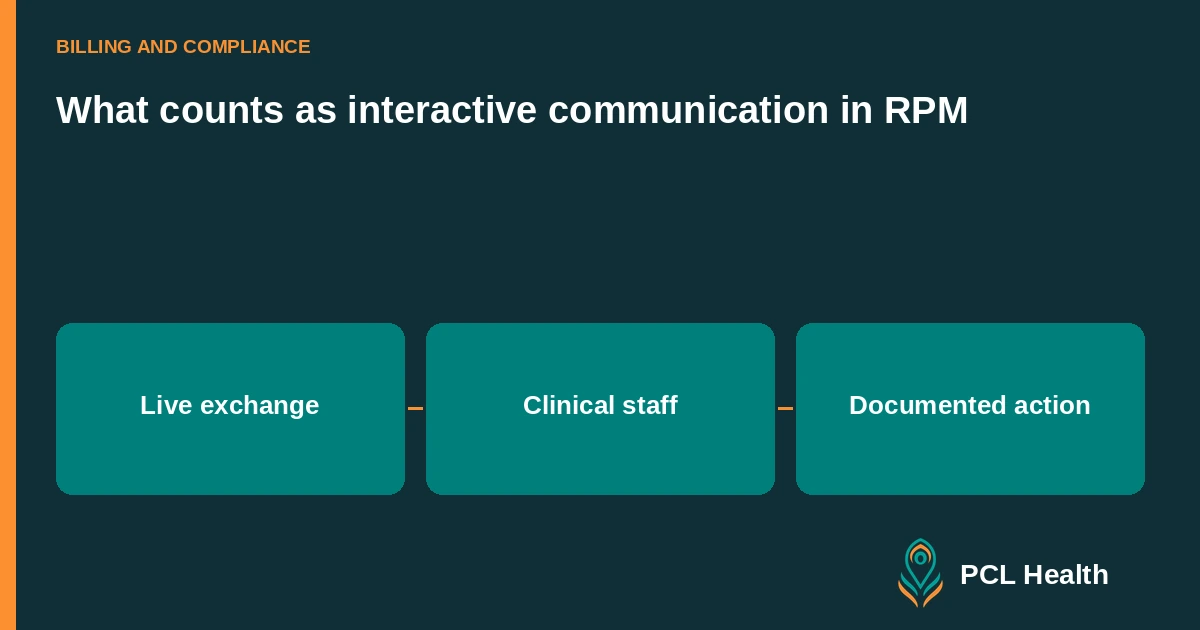
RPM interactive communication is a live, two-way conversation between the patient or caregiver and the practitioner or clinical staff. A voicemail, unanswered call or automated AI reminder does not establish that interaction.
CMS describes this requirement for 99457 and 99458 in its CY 2021 final-rule explanation. The practical task for your practice is to make the qualifying conversation identifiable in the record, alongside the other care management work performed during the month.
What makes a conversation interactive communication?
The exchange must happen in real time and allow both sides to participate. For the RPM services described by 99457 and 99458, CMS explains that interaction as synchronous, two-way communication. Your documentation should show the actual conversation with the patient or caregiver, who conducted it and what monitoring-related issue was addressed.
The CMS 2021 explanation also clarifies that required time can include care management work alongside the interactive communication. Treat communication and total time as separate review questions. A timer reaching a threshold cannot establish that a conversation took place.
Suppose a nurse in a cardiology practice reviews a patient's transmitted readings, then speaks with the patient about the monitoring plan and an unresolved question. The record should describe those activities separately. Your reviewer should be able to see the review work and the live exchange without guessing from a combined duration.
Do voicemail, texts or automated calls count?
A voicemail or asynchronous message does not establish a real-time, two-way conversation. An automated AI call supports follow-up but should not be presented as meeting this requirement. Preserve those contacts in the activity history and identify the separate practitioner or clinical-staff interaction your billing reviewer will assess against the applicable rules.
Use distinct outcome labels in your workflow. “Attempted,” “message left,” “automated reminder completed” and “staff conversation completed” describe different events. If your record lists each as “call,” ask staff to clarify the entry before using it in billing review.
| Event | What the event establishes | Review action |
|---|---|---|
| Unanswered staff call | A contact attempt | Keep the follow-up open |
| Voicemail left | A recorded message | Arrange the live exchange as appropriate |
| Automated AI reminder | An automated contact | Separate it from qualifying staff communication |
| Live staff conversation | A real-time exchange | Review the content, personnel and other code requirements |
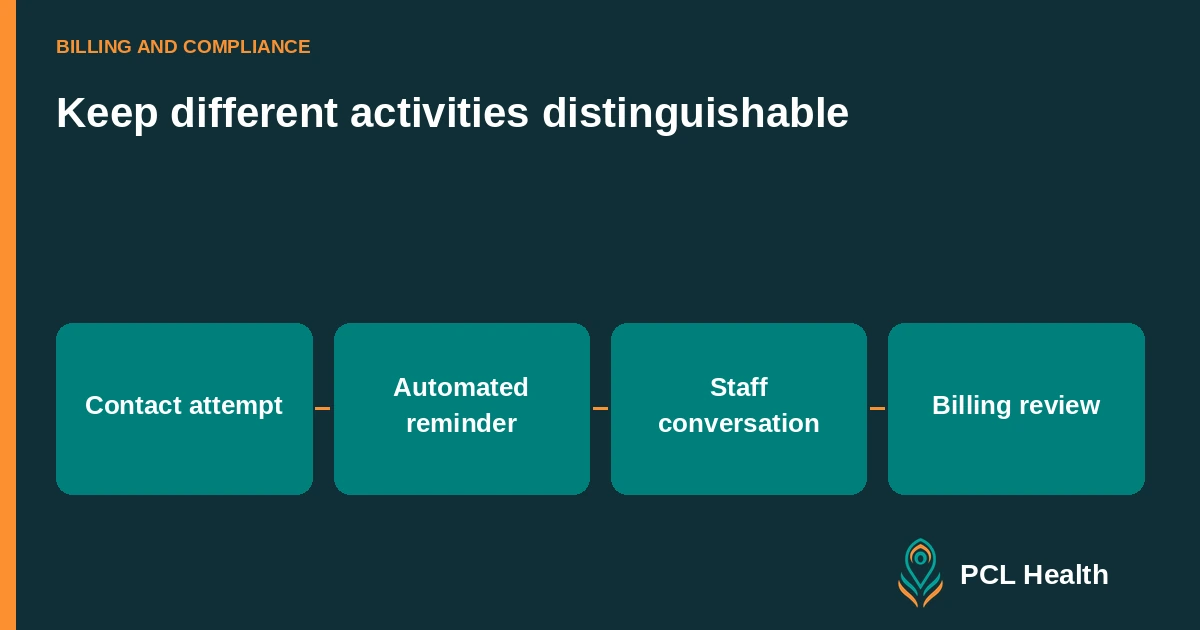
These distinctions apply the communication definition in CMS's CY 2021 explanation. For the wider workflow, see the AI follow-up calls guide.
Does the entire time requirement have to be a live call?
CMS states that time for 99457 and 99458 can include care management services as well as the required interactive communication. The record therefore needs both the conversation and the other qualifying work. Your billing staff must review the relevant service, personnel, reporting period and time rather than equating total activity with telephone minutes.
That clarification appears in the CY 2021 final-rule explanation. Ask your team to document what the work involved. A note that says “RPM time” leaves the reviewer with a total and no account of the activity behind it.
Separate automated system activity from work personally performed by staff. If a coordinator reviews an AI call summary and takes a follow-up action, record the coordinator's actual activity. Do not substitute the duration of the automated call for the time the coordinator spent on their own work.
What should staff document after the conversation?
Make the exchange easy to reconstruct. Record who participated, which staff member conducted it, the monitoring-related subject and the next action. Keep the date of service and actual staff time in the patient record. Your practice can use a consistent checklist to improve record clarity without replacing payer-specific review.
Use a short structure: reason for contact, information reviewed, patient or caregiver response, action and responsible person. Capture the details while they are fresh. If the next action belongs to another team member, name the owner and show whether the handoff remains open.
This is a suggested documentation checklist. Your billing staff should compare the record with CMS remote monitoring guidance (December 2025) and current payer requirements. A complete-looking note still needs that review.
PCL Health summarizes automated missed-reading and monthly report calls in the care plan. The AI voice calls page shows the supported workflow; keep the separate human conversation identifiable when reviewing treatment management activity.
How should you review a month with several contact attempts?
Review the month as a sequence of events. Identify attempts, completed automated contacts, live staff conversations and subsequent actions separately. Find the evidence supporting each requirement before deciding whether the record supports billing. When the documentation is ambiguous, return it to the person who performed the work for clarification.
For example, a patient may miss a call on Tuesday, receive a reminder on Wednesday and speak with the nurse on Thursday. The first two entries explain how contact developed. The Thursday entry should describe the actual conversation and its relationship to the monitoring work.
Build a review queue for records needing clarification. Give the reviewer a way to return a question to the responsible staff member. The RPM billing requirements guide covers the broader evidence review; the 90-day program plan covers setting up the staff process.
Run a small weekly check while the process is new. Choose a record with an unanswered call, one with an automated reminder and one with a completed staff conversation. Ask the reviewer to identify each event without help from the author. Any uncertainty points to a label or documentation habit that needs attention.
Use that feedback to improve the workflow at the point where staff record the activity. Adding another month-end checklist will not solve a confusing entry made weeks earlier. Your goal is a record that the next team member can understand without calling the original coordinator.
Main guide: RPM billing requirements
FAQ
Does voicemail count as RPM interactive communication?
A voicemail does not establish a real-time, two-way exchange. Record the message as a contact attempt and identify the separate live conversation.
Can an automated AI call meet the requirement?
An automated AI call supports follow-up but should not be treated as qualifying interactive communication. Keep the actual practitioner or clinical-staff conversation separately documented.
Must all treatment management time be spent on a live call?
CMS's CY 2021 explanation says time can include care management services alongside the required interactive communication. Your billing staff should review the documented activities and current payer requirements. Source.
Does a call log establish claim eligibility?
A call log helps show the contact history. Billing review still needs the conversation content, responsible personnel and evidence for the other applicable requirements. Source.
Sources
This article is general information, not billing or legal advice. Confirm current payer requirements before submitting claims.