
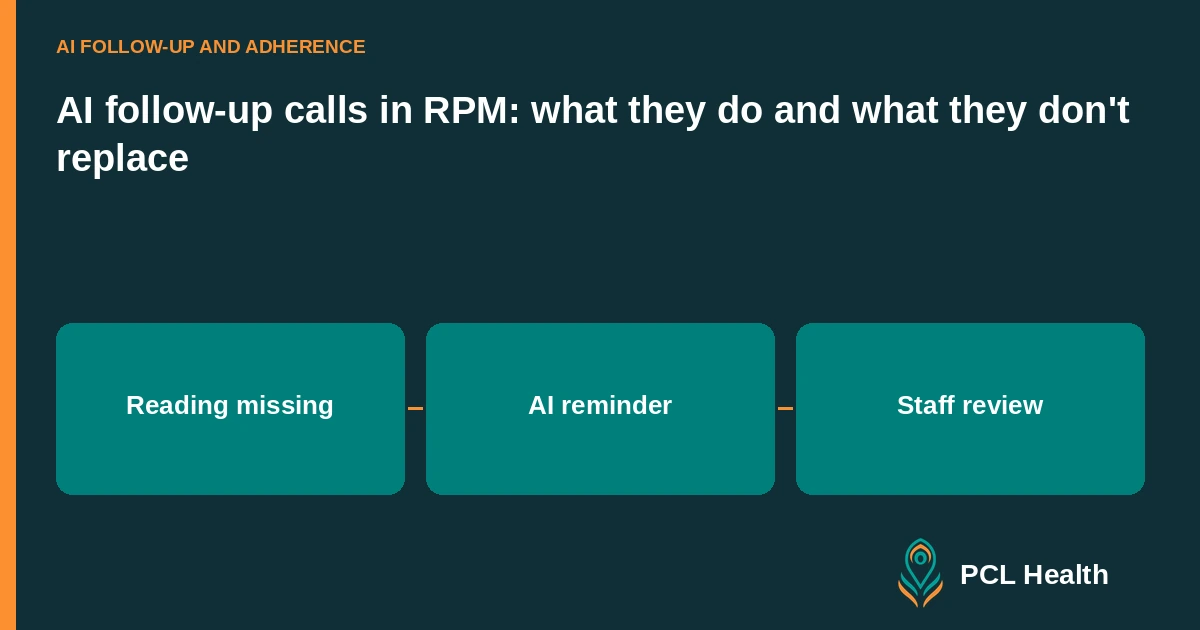
AI follow-up calls in RPM can remind patients about missing readings and communicate routine monitoring reports. Your clinical team still owns the review, patient conversations and decisions that turn those contacts into care.
The useful question is where a call fits in your working day. A reminder can reach a patient while your coordinator handles enrollment or reviews another record. The next step must still be clear: what happened, who needs to review it and what action remains open.
Where do AI patient follow-up calls fit in an RPM workflow?
Place AI calls between detecting a routine follow-up need and reviewing the result. Use a defined trigger, a narrow purpose and a named owner for the next step. Keep the call outcome connected to the patient's record so your team can distinguish a completed reminder from an issue still needing attention.
Start with one job. For missed readings, the job is to prompt the patient to take the reading already requested by the care team. For a monthly report, the job is to communicate the report within a defined process. Give staff a clear route for questions that need a clinician.
Consider a cardiology practice opening its monitoring queue on Monday morning. Some patients have transmitted readings, others have not, and one patient needs help pairing a device. Sending the same reminder to all three groups would create work. Review the trigger before deciding who should receive a call.
Write the workflow on one page: the event that starts contact, the approved purpose, the information available to the caller, the outcome categories and the person who reviews them. This is a suggested operating checklist for your team to adapt to its own program.
Which routine tasks should you start with?
Start with repeatable contacts whose purpose you can explain in one sentence. Missed-reading reminders and monthly report calls are practical starting points. Before launch, agree what the call should cover, what it should leave for staff and how the team will recognize an unsuccessful or incomplete contact.
A missed-reading call should be tied to the schedule your practice has given the patient. Review whether the reading is actually absent from the clinical workspace before contacting someone who may already have taken it. A device display and a transmitted record can tell different stories.
A monthly report call serves a different purpose. Keep it separate from a request to take today's reading. Your team should agree which report is being discussed and where staff will find the corresponding record afterward. The patient should have a clear way to ask the practice a question.
| Contact | Purpose | What staff review next |
|---|---|---|
| Missed-reading reminder | Prompt the requested reading | Whether a new reading arrived and any unresolved barrier |
| Monthly report call | Communicate the monitoring report | The summary and any question requiring a response |
| Incomplete contact | Record that follow-up remains open | The next contact method and responsible person |
For PCL Health, the supplied workflow includes missed-reading and monthly report calls, with each call summarized in the patient's care plan. You can explore the AI voice calls workflow when comparing that process with your team's needs.
What should an AI call summary tell your team?
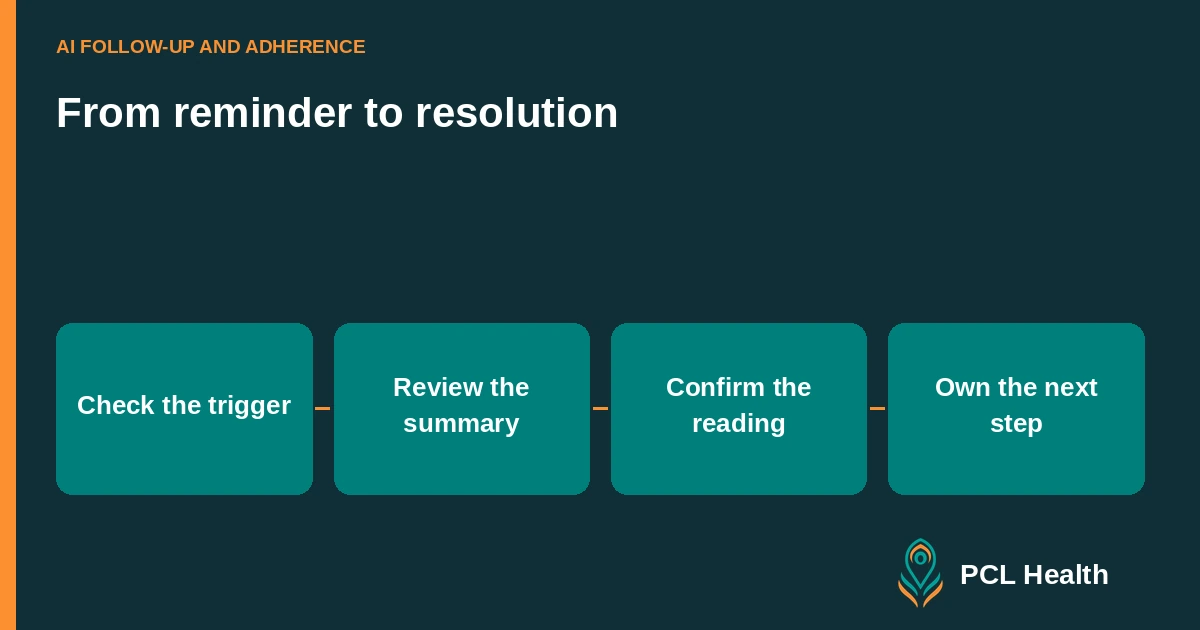
A useful summary tells staff why the call happened, its outcome and what needs to happen next. Keep completion, patient response and follow-up action distinct. Review the summary alongside the readings and care plan; a completed call does not tell you whether the patient subsequently transmitted the requested measurement.
Compare these two notes: “Call completed” and “Reminder call completed. Patient was prompted to take today's reading.” The second tells your coordinator the purpose of the contact. It still leaves a separate question: did the reading arrive? Keep that question visible until someone checks.
Agree a consistent review pattern. Staff should look for an unanswered question, a reported technical problem or a request to speak with the team. Ask the vendor to demonstrate how each outcome is recorded. Verify the actual behavior before depending on it in your workflow.
Keep summaries factual. An attempted contact, a conversation and a received reading are different events. If a patient says the device was used, staff should confirm transmission separately. Avoid turning a patient's reported intention into a statement that the measurement was completed.
Do AI calls meet RPM interactive communication requirements?
An automated AI call supports the program; your billing workflow must not treat it as meeting the RPM interactive communication requirement. CMS describes qualifying communication for 99457 and 99458 as a real-time, two-way exchange. Record the actual practitioner or clinical-staff interaction separately from automated contact and review the applicable requirements.
CMS's CY 2021 final-rule explanation says the required time can include care management work as well as the interactive communication. It does not turn an automated reminder into a practitioner or clinical-staff conversation.
Make this distinction visible in your records. An AI call outcome belongs in the follow-up history. Staff work belongs in a record of who performed the activity, what they did and the time spent. Your billing reviewer should be able to identify the qualifying communication without inferring it from a call total.
At month end, ask for one patient record showing both kinds of activity. Check that staff can explain which entry represents their conversation with the patient and which represents an automated reminder. Read the RPM billing requirements guide alongside that review.
What must remain with your clinical team?
Your team needs ownership of reviewing readings, resolving patient questions and deciding what action the care plan requires. Assign a responsible person and a backup for each queue. Define how staff receive unfinished contacts and technical problems, then test the handoff before increasing the number of patients receiving calls.
Separate the technical and clinical paths. A pairing problem needs someone who can troubleshoot the device and app. A question about the care plan needs the appropriate clinical team member. Sending both to an unnamed “follow-up queue” makes ownership harder to see.
Write down what happens when the usual coordinator is absent. Someone must know where to find the call summaries and which entries require review. A workflow that depends on one person's memory will be difficult to run during leave or a busy clinic session.
Give patients the practice's contact instructions, including how to seek help outside the monitoring team's working hours. HHS recommends planning staffing, technology support and responsibility outside normal business hours in its RPM strategy guidance (2026). Use those decisions to set the boundaries of your calling process.
How should you introduce automated calls to patients?
Explain who will call, why the contact happens and how the patient can reach your team. Demonstrate the expected experience during onboarding. Confirm the patient's preferred contact details and practical needs, then offer a staff-led route for someone who cannot use or does not want the automated calling process.
A patient should recognize the purpose of the contact before receiving the first reminder. Include the call in your onboarding explanation rather than introducing it after a missed reading. Ask the patient to describe what they would do if they had a question the call could not resolve.
Test the experience with staff before inviting patients. Check how an unanswered call, a wrong number and an unclear response are handled. Ask specifically about identity checks, information disclosed before identification and recording settings. Treat the answers as vendor questions until you have seen the actual configuration.
HHS's patient RPM guidance emphasizes understanding the device, transmission process and who to contact for help. Your call explanation should reinforce those instructions. Use the language patients already heard from the care team.
How do you know whether the workflow is working?
Review what happened after each contact, rather than counting calls alone. Look at received readings, unresolved barriers, requests for staff help and the time needed to close the queue. Compare the recorded outcome with the patient's subsequent activity and ask staff whether the summary was enough to make the next step clear.
Choose a small starting group and a defined review period. Inspect individual records, including calls that did not connect. If a reminder went to someone whose reading was already present, investigate the trigger. If the summary was unclear, correct the review process before expanding.
Keep a simple issue list: timing, contact details, technical barriers, patient questions and unclear handoffs. Assign an owner to each recurring problem. Review the list with the people who answer the follow-up calls, not only the person administering the software.
HHS's 2026 strategy guidance recommends defining roles and measuring program activity. You can apply that approach by tracking whether the workflow reaches a clear resolution. Set your own baseline before making any statement about workload or results.
What does the proposed 2027 rule mean for this workflow?
Keep the software purchase and the staffing plan as separate decisions. The July 2026 CMS proposal would require directly employed clinical staff for the covered remote monitoring work. An automated calling workflow would still need accountable staff review, and the proposed policy must remain separate from the requirements currently in effect.
CMS proposes a separately reportable initiating visit and revisions to remote monitoring valuations, and sought comment on code consolidation. January 1, 2027 is the proposed effective date; the comment period closed September 14, 2026. Practices could still obtain devices, software and platforms from vendors under the proposed staffing approach. See the 2027 proposed-rule record, CMS fact sheet (2026) and full proposed rule (2026).
Your next practical step is to map the handoff from automated contact to staff review. The practice-manager checklist provides the broader policy review. Keep both the current workflow and any proposed changes clear to your team.
For the day-to-day sequence, use the 48-hour missed-readings workflow. For a closer billing review, use the interactive communication guide. Keep those handoffs visible when you introduce automated calling.
Main guide: This article is the main guide for AI follow-up and adherence.
FAQ
Can an automated AI call count as RPM interactive communication?
An automated AI call supports the program and should not be recorded as meeting the requirement. CMS describes interactive communication for 99457 and 99458 as a real-time, two-way exchange with the practitioner or clinical staff. Source.
What calls does PCL Health provide?
PCL Health provides missed-reading follow-up calls and monthly report calls. Each call is summarized in the patient's care plan.
Does a completed reminder mean a reading was received?
A completed reminder records the contact. Your team still needs to check whether the requested reading was transmitted and whether any barrier remains unresolved.
What should staff review after an automated call?
Staff should review the outcome, unresolved questions and the next action. Assign a named reviewer and a backup so the contact does not end in an unowned queue.