
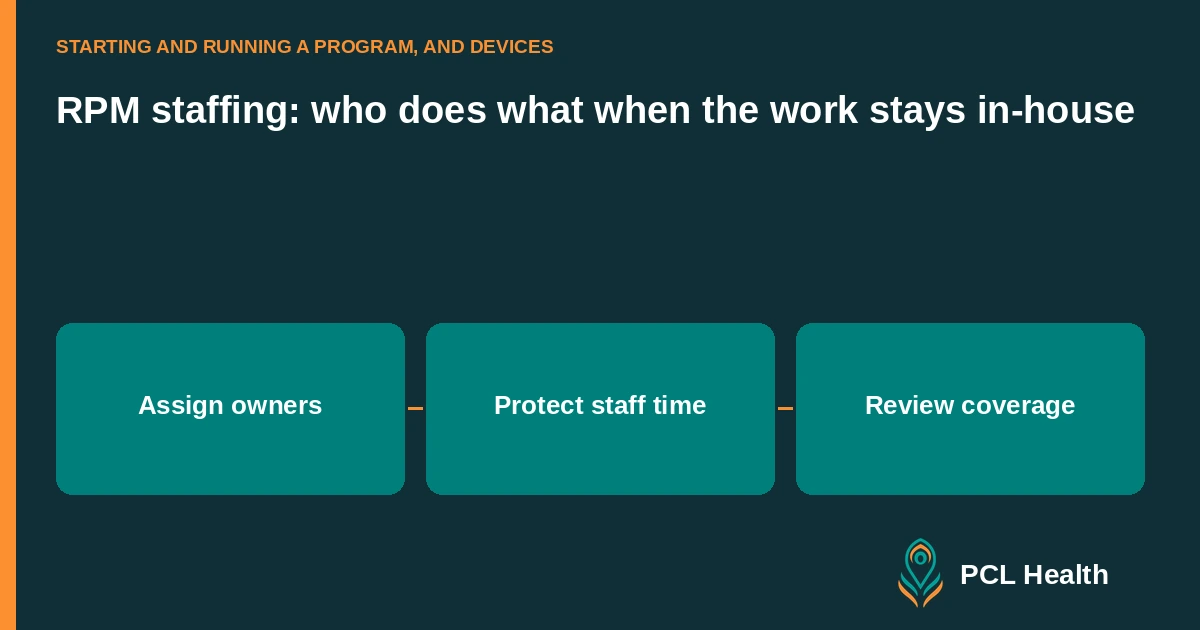
An in-house RPM staffing model assigns enrollment, technical support, monitoring, patient communication and billing review to named people in your practice. Start with the work and its coverage needs, then decide which responsibilities each team member can carry.
HHS recommends planning patient recruitment, data monitoring, technical support and education in its RPM strategy guidance (2026). A role list becomes useful when it also explains who covers leave, who receives unresolved work and how the clinical team reviews concerns.
Which responsibilities need a named owner?
Assign owners for enrollment, device setup, data review, patient follow-up, clinical escalation and billing review. Name a backup for each function and define the handoff between roles. One person may hold several responsibilities, but staff should always know who owns an open item and where to find its current status.
Start with a responsibility table rather than a hiring target. There is no universal patient-to-nurse ratio in this operating plan. Your staffing decision should come from the work your team actually performs, including calls that do not connect, device problems and questions requiring practitioner review.
| Function | Suggested owner | Handoff to define |
|---|---|---|
| Enrollment and scheduling | Coordinator | Clinical approval and setup appointment |
| Device and app support | Trained support staff | Unresolved connection problem |
| Readings and patient communication | Appropriate clinical staff | Question or alert requiring practitioner action |
| Care plan decisions | Responsible practitioner | Instructions for patient and monitoring team |
| Documentation and billing review | Designated reviewer | Record requiring clarification |
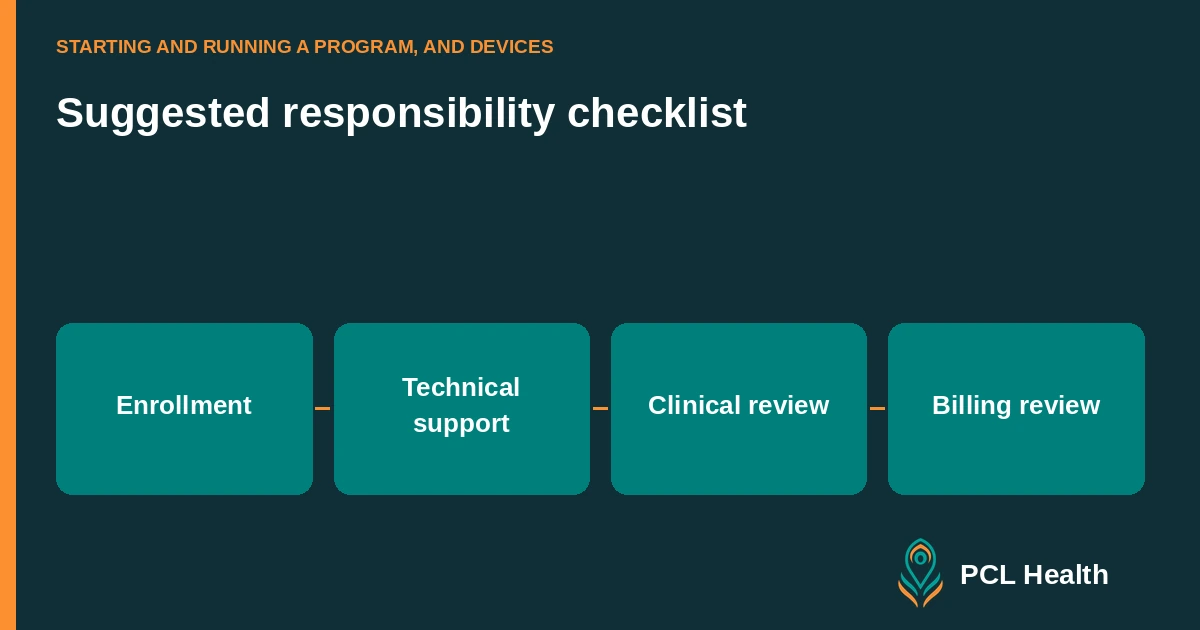
This is a suggested allocation of work. Check each person's permitted duties, training and applicable supervision requirements before assigning clinical activity. CMS describes RPM personnel and supervision in its remote monitoring guidance (December 2025).
How should you organize the working day?
Give the monitoring work protected time and a clear review sequence. Start with items needing clinical attention, then review missing readings, technical barriers and routine follow-up. End with a handoff of unresolved work. Set the actual priority and response arrangements with your clinical lead rather than letting a dashboard's default order decide them.
A kidney practice might begin with a brief review of the open queue, followed by planned patient contacts and device troubleshooting. Before the afternoon clinic starts, the coordinator passes unresolved clinical questions to the responsible practitioner. The next staff member can see which items have already been acted on.
Specify when the queue is reviewed and who checks it during absence. HHS's 2026 strategy guidance asks practices to consider monitoring outside normal business hours. Decide and communicate your own coverage arrangement before enrollment grows.
The PCL Health workflow for clinics brings readings, care plans and follow-up into the platform. Your practice still needs to assign the staff who review that work and respond to the patient.
How do you estimate workload without guessing a staffing ratio?
Measure the tasks in a limited launch before expanding. Track time spent on enrollment, technical support, review, patient contact and documentation separately. Include unfinished work and repeat attempts. Use the pattern across several working days to decide whether responsibilities fit the available staff time and where additional coverage is needed.
Keep the measurement simple. Staff can record the task category, actual time and reason for any repeat work. Look for patterns such as repeated pairing help or a queue that is consistently handed over unfinished. Those observations tell you more than the number of enrolled patients alone.
Review the process with the people doing the work. A long setup appointment may reflect unclear instructions rather than insufficient staffing. A recurring clinical question may need a better handoff. Fix the underlying task before deciding to add another person or enlarge the cohort.
What does the 2027 staffing proposal change?
CMS proposes that clinical staff performing the covered remote monitoring work must be direct employees of the practitioner or practice. For a practice using vendor-employed nurses, that would change who can perform the work for Medicare billing if finalized. Keep your current staffing arrangements and the proposed future model separately documented while awaiting the final rule.
The full proposed rule (2026) identifies January 1, 2027 as the start of the proposed staffing change. The comment period closed September 14, 2026, according to the CMS rule record (2026). These remain proposals.
CMS also proposes a separately reportable initiating visit and lower valuations for some remote monitoring services, and sought comment on consolidating the code families. See the 2027 proposed-rule fact sheet (2026) and full rule. The proposed restriction concerns the staffing of the service; practices could still buy software, devices and platforms from vendors.
Consider a cardiology practice whose RPM vendor's nurses currently review readings and make patient calls. Its contingency plan would identify practice-employed staff for that work, protected review time and a handover process. Buying the existing software would be a separate decision from employing the people delivering the service.
What should your contingency plan contain?
Prepare a responsibility map, a capacity review and a handover checklist. Identify which activities currently sit with a vendor, what records your practice needs and who would perform those tasks internally. Make any implementation decision against the final published rule and your payer requirements, while using the proposal to identify practical gaps now.
Ask who controls the open patient queue, how staff will see previous contact and where unresolved issues are recorded. Set a plan for device support and patient communication during any transition. Include the people responsible for scheduling and billing review, not just the clinical lead.
An automated AI call can support follow-up, but it does not establish qualifying interactive communication. CMS describes the live exchange in its CY 2021 explanation. Keep staff activity separately documented as you consider automation.
Use the 2027 practice-manager checklist for the policy review and the outsourced versus in-house guide for the business-model discussion. Your staffing plan should end with a named owner for every part of the patient's working-day experience.
Main guide: How to start an RPM program
FAQ
Who should own an in-house RPM program?
Name a responsible practitioner and an operational lead. Assign the day-to-day tasks and backups explicitly so the next action always has an owner.
How many patients can one nurse monitor?
Capacity depends on your enrollment, support, review and patient-contact workload. Measure those tasks in a limited launch before deciding how many patients fit the team's available time.
Has the proposed direct-employment requirement taken effect?
The July 2026 proposal identifies January 1, 2027 for the proposed staffing change. The final rule has not yet been published, so the proposal must remain distinct from current requirements. Source.
Could a practice still buy an RPM platform from a vendor?
The proposed restriction concerns the clinical staffing of the service. Practices could still obtain software, devices and platforms from vendors while planning who performs the monitoring work.
Sources
This article is general information, not billing or legal advice. Confirm current payer requirements before submitting claims.